

Home>
Resources>
Learning>
Articles>
Cell‑based Assay & Phenotypic Screening: Workflow, Advantages and CRO Service Solutions
Cell‑based Assay & Phenotypic Screening: Workflow, Advantages and CRO Service Solutions
What Is Cell‑based Assay in Drug Screening
Cell‑based assay is an essential preclinical research approach that evaluates compound bioactivity inside living cell systems. Unlike pure biochemical target screening carried out in test tubes, cell‑based assays reflect real‑world biological conditions, enabling researchers to observe compound penetration, metabolic effects and cellular phenotypic responses. This screening method has been widely adopted by biotech and pharmaceutical teams for early‑stage lead compound identification. The cell‑based drug screening service helps reduce late‑stage drug development failure risk by filtering out compounds that perform well in isolated protein assays but fail inside living cells.
Standard Workflow of Cell-based Assay Screening
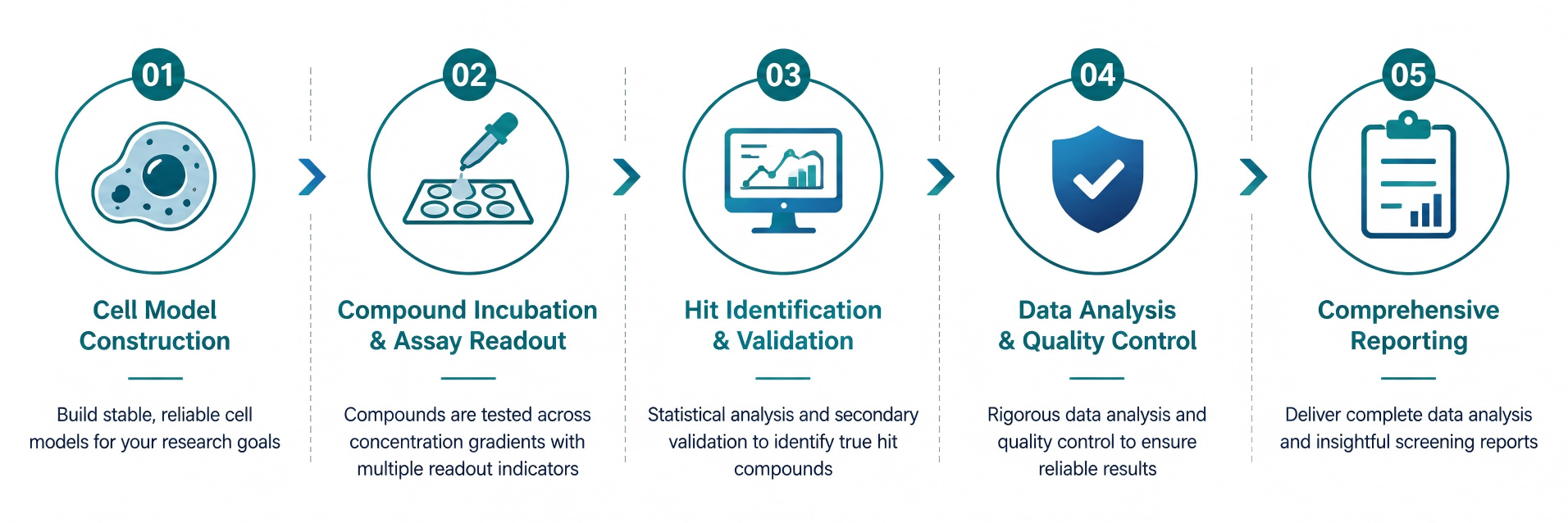
A complete cell-based screening project follows standardized experimental steps to guarantee repeatable and reliable screening outcomes.
Cell Model Construction
The first step is to build stable or transient cell models matching research goals, including disease-relevant cell lines, primary cells or genetically modified cell strains. Cell quality, culture condition and cell passage status are strictly controlled to avoid deviation of final screening data.
Compound Incubation & Assay Readout
Test compounds are added to cell culture plates under controlled concentration gradients. After sufficient incubation periods, multiple readout indicators are detected, including cell viability, apoptosis marker expression, reporter-gene signal and other phenotypic parameters according to project requirements.
Hit Compound Identification & Data Validation
Primary screening raw data goes through statistical filtering to pick out potential hit compounds. Positive hits will move into secondary validation assays to eliminate false-positive results, narrowing down candidate molecules for follow-up pharmacological research.
Key Advantages of Cell-based Assays vs Biochemical Target Screening
Traditional biochemical screening only tests compound-target protein binding in vitro assay environments. Cell-based screening brings obvious additional value for preclinical drug discovery. It simulates complex intracellular environment, taking cell permeability, compound metabolism and off-target cellular toxicity into consideration. Researchers can observe real phenotypic changes instead of merely molecular-level binding data. For phenotypic drug discovery without clear known targets, cell-based screening becomes one of the most feasible screening strategies.
Limitations to Consider in Cell-based Assays
Despite its benefits, cell-based drug screening also has inherent constraints. Cell culture stability will influence result consistency; some complex primary cell models may have higher experimental cost and longer turnaround time. Researchers need to balance assay throughput and biological relevance when designing screening projects.
Reqbio Cell-based Screening CRO Capabilities
As a professional preclinical CRO provider, Reqbio offers customizable cell-based screening solutions for global biotech and pharma partners. Our service covers assay development, cell model construction, compound library screening, hit validation and complete analytical report delivery. We can adjust screening scale, readout indicators and experimental protocols according to unique project objectives, helping clients accelerate preclinical hit identification and lower internal R&D resource pressure. If you are looking for reliable preclinical screening support, please check our custom drug-screening service for tailored project consultation.
FAQ
When should I choose cell-based assay or phenotypic screening?
Cell‑based assay is highly recommended when you need to evaluate compound functional response within living biological systems, conduct phenotypic screening without well‑defined targets, or verify hit compounds obtained from biochemical target‑based screening.
Conclusion
Cell‑based assay occupies an irreplaceable position in modern preclinical drug discovery. It bridges the gap between molecular‑level biochemical experiments and in‑vivo animal studies. Selecting a qualified CRO partner with mature assay systems can greatly improve screening efficiency and data reliability. Contact our team to discuss your cell‑based screening project requirements.


news recommendation
CaSR: The Calcium Homeostasis Sentinel and a Core GPCR Target for Metabolic and Kidney Disease Research
CD3E: The T-Cell Activation Switch and Cell Models for Targeted Therapeutics
NFAT Signaling Pathway: A Critical Target for Drug R&D and Cell Models
TSHR Cell Model for Thyroid Cancer Drug Screening | GPCR Assay Platform-Reqbio
We Are Pleased to Announce: Global Commercial Licensing Rights for Jurkat E6.1, CHO-K1, HEK293, THP-1 and RAJI Cell Lines Officially Secured.
Explore