

Gene Knockdown
Accelerate Gene Function Validation with Targeted RNAi Solutions
Gene knockdown is a well-established RNA interference (RNAi) approach for reducing target gene expression without permanently altering genomic DNA. By selectively targeting target gene mRNA, RNAi enables researchers to modulate gene expression and investigate gene function, signaling pathways, disease mechanisms, and therapeutic targets.
Our siRNA and shRNA gene knockdown services provide flexible solutions for both short-term and long-term research applications. From target sequence design and RNA synthesis to cellular delivery, knockdown validation, and stable cell model generation, we provide an integrated workflow tailored to your experimental objectives.
Our Gene Knockdown Technology
We offer two complementary RNAi platforms to support different experimental needs:
siRNA-Mediated Transient Knockdown
Fast, flexible, and ideal for short-term studies
Chemically synthesized siRNA is introduced directly into cells and incorporated into the RNA-induced silencing complex (RISC), enabling sequence-specific degradation of target mRNA and rapid suppression of gene expression.
Typical characteristics:
- Rapid onset of gene silencing
- Typically detectable within 24–72 hours
- Knockdown effects generally maintained for 3–7 days
- No genomic integration
- Simple and efficient experimental workflow
- Well suited for preliminary target validation and short-term phenotype studies
Recommended applications:
Target screening, gene function validation, short-term phenotypic assays, and high-throughput screening.
shRNA-Mediated Stable Knockdown
Long-term silencing for advanced functional and mechanistic studies
shRNA is expressed from a suitable delivery vector and processed intracellularly into functional siRNA, enabling sustained targeting of the corresponding mRNA. Combined with selection and clonal isolation, this approach can be used to establish stable knockdown cell models.
Typical characteristics:
- Sustained gene silencing
- Stable expression through cell passaging
- Suitable for long-term functional studies
- Supports stable knockdown cell line generation
- Compatible with viral delivery strategies when required
- Suitable for extended mechanistic and in vivo studies
Recommended applications:
Long-term functional studies, molecular mechanism research, stable cell model development, and in vivo gene intervention studies.
End-to-End Gene Knockdown Services
We provide an integrated workflow covering target design, reagent preparation, cellular delivery, knockdown validation, and data analysis.
siRNA Knockdown Services
01 | Target Selection & siRNA Design
We design and evaluate multiple candidate siRNA sequences for commonly used experimental species, including human, mouse, and rat. Multiple candidates are screened to identify sequences with high predicted specificity and efficient gene silencing.
02 | Custom siRNA Synthesis
High-purity siRNAs are chemically synthesized and subjected to purification and quality-control procedures to ensure product integrity and suitability for downstream experiments.
03 | Cell Transfection Optimization
Transfection conditions are optimized according to cell type, including reagent selection, siRNA concentration, and incubation parameters, with the goal of achieving efficient delivery while maintaining cell viability.
04 | Knockdown Validation
Gene silencing is evaluated at both the mRNA and protein levels using qPCR and Western blotting, providing comprehensive confirmation of knockdown efficiency.
05 | Data & Deliverables
Deliverables may include purified siRNA products, experimental raw data, knockdown efficiency reports, and complete experimental records.
shRNA Stable Knockdown Services
01 | shRNA Sequence Design & Optimization
Multiple candidate sequences are evaluated to identify shRNAs with high specificity and effective silencing activity. Appropriate negative and empty-vector controls are incorporated into the experimental design.
02 | shRNA Vector Construction
shRNA expression vectors are constructed using commonly used promoters such as U6 or CMV, with optional fluorescent reporters and selectable markers to facilitate downstream screening and validation.
03 | Viral Packaging — Optional
Lentiviral, adenoviral, and AAV packaging options are available for applications involving difficult-to-transfect cells, primary cells, and selected in vivo studies.
04 | Cell Transduction & Selection
Cells are transduced and subjected to appropriate selection procedures to establish stable knockdown populations or monoclonal cell lines.
05 | Stable Knockdown Validation
Target gene expression is evaluated through repeated qPCR and protein-level analyses to confirm sustained knockdown and experimental reproducibility.
06 | Final Deliverables
Depending on the project design, deliverables may include shRNA plasmid vectors, viral particles, stable knockdown cell lines, validation data, and a comprehensive experimental report.
A Streamlined Workflow from Design to Validation
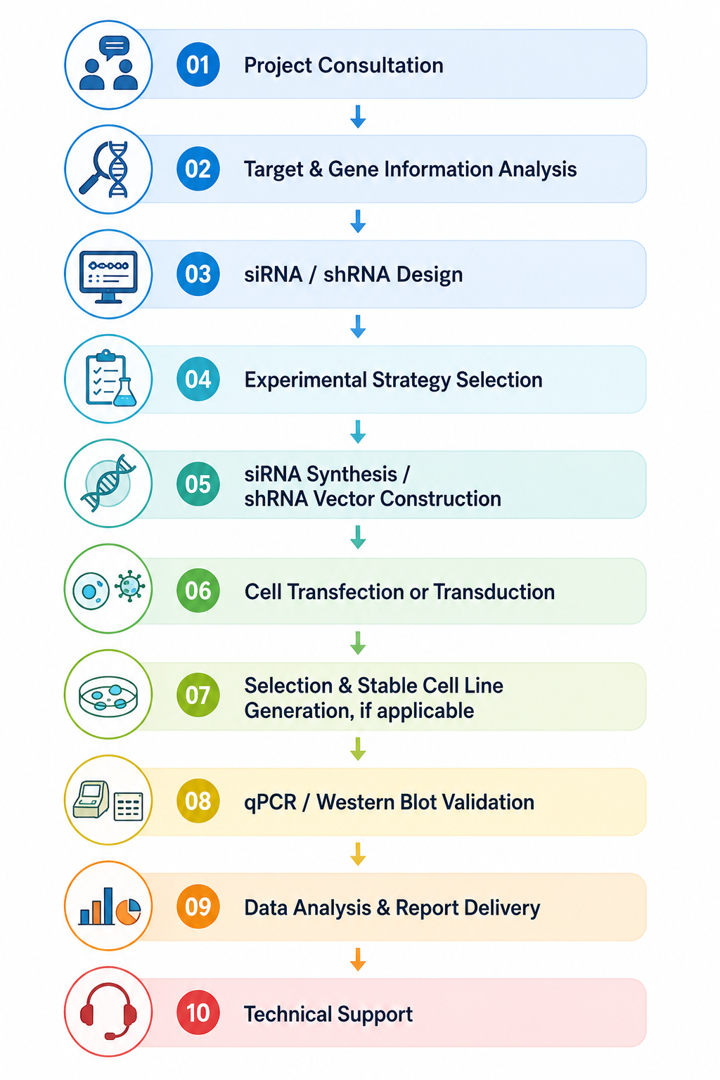
Our standardized workflow is designed to provide consistent execution, transparent data, and reliable experimental outcomes from initial target selection through final validation.
Why Choose Our Gene Knockdown Services?
Integrated RNAi Expertise
Our platform combines siRNA transient knockdown and shRNA stable knockdown capabilities, allowing researchers to select the most appropriate strategy for their experimental objectives.
Designed for Research Flexibility
Whether you need rapid target validation or a long-term stable knockdown model, our workflows can be adapted to different cell types, research timelines, and study objectives.
Multiple-Layer Specificity Control
Candidate sequence screening, sequence optimization, and appropriate experimental controls are incorporated to help minimize off-target effects and improve the reliability and reproducibility of experimental results.
Quality Control Throughout the Workflow
Quality control is integrated across the entire service process—from target design and reagent preparation to cellular experiments and knockdown validation.
One-Stop CRO Service
From experimental design to execution, validation, and data analysis, we provide an integrated service that reduces operational complexity and allows researchers to focus on scientific interpretation and downstream discovery.
Applications Across Biomedical Research
Our gene knockdown platform can support a broad range of basic and early-stage translational research programs, including:
- Gene Function Validation
- Cancer Biology & Disease Mechanism Studies
- Cell Signaling Pathway Analysis
- Drug Target Screening & Validation
- Gene Expression Regulation Studies
- Cellular Phenotype Modulation
- Long-Term Gene Silencing Studies
- Stable Knockdown Cell Model Generation
- In Vivo Gene Intervention Studies
From Target to Mechanism — Build the Right Knockdown Model for Your Research
Whether your project requires rapid siRNA-mediated target validation or long-term shRNA-mediated stable gene silencing, our gene knockdown services provide a flexible and integrated solution for gene function studies, mechanism research, and early-stage drug discovery.
Talk to our technical team about your target and experimental requirements.
Other stable cell lines
If you are interested in ordering, please contact us.
Customer help-line
4008-750-250
sales@reqbio.com
Office address:
3rd Floor, No. 6, Lane 222, Guangdan Road, Pudong New Area, Shanghai, China
We Are Pleased to Announce: Global Commercial Licensing Rights for Jurkat E6.1, CHO-K1, HEK293, THP-1 and RAJI Cell Lines Officially Secured.
Explore