

Flp-FRT Targeted Integration
Definition
Flp: Flp (flippase) recombinase is a site-specific recombination enzyme derived from yeast. The FLP gene is approximately 1272 bp in length and encodes a 423-amino-acid polypeptide with a molecular weight of approximately 48 kDa. Flp functions as a monomer.
FRT: FRT (Flp Recombination Target) is the specific DNA sequence recognized by Flp recombinase. The FRT site is 48 bp in length and consists of two 13-bp inverted repeats flanking an 8-bp asymmetric spacer, along with an additional 13-bp repeat. The inverted repeats serve as Flp binding sites, while the spacer region defines the recombination site and confers directionality to the recombination event.
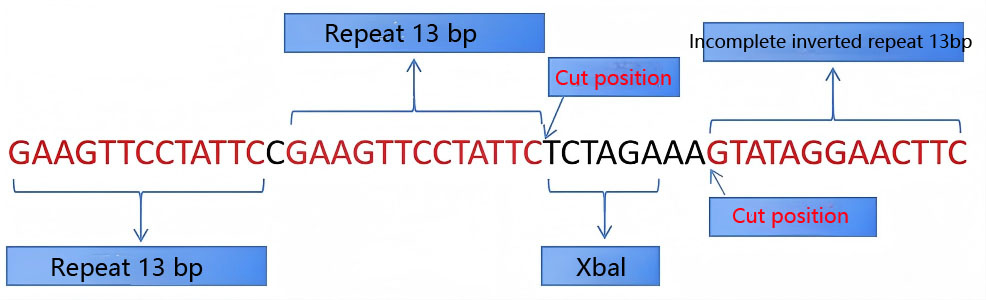
The Flp-FRT site-directed integration system
We often use the transfection of chemical reagents have Lipofectamine/CaPO4 / FuGene/PEI, basic principle is the same:
The Flp–FRT integration system is a site-specific recombination approach for generating stable cell lines with targeted insertion of a gene of interest into the host genome. By utilizing Flp recombinase and defined FRT sites, this system enables precise genomic integration and supports stable, long-term expression of the transgene, ensuring continuous protein production.
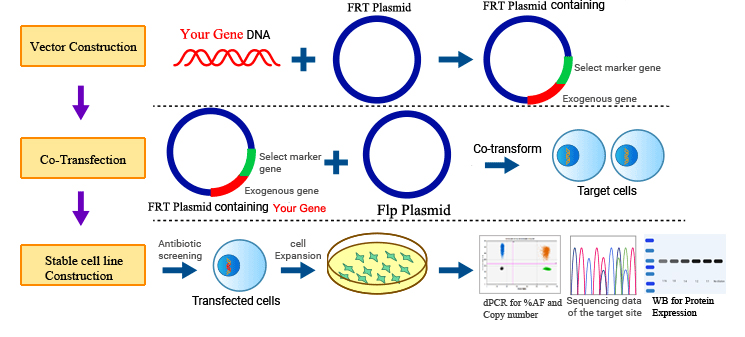
Working Principle
1. Construction of Flp-FRT Cells:
The Flp recombination target site (FRT) is introduced into the genome of the host cell line. The general structure is ATG + FRT + resistance gene. Based on the transfection strategy selected for the parent cell, stable cell lines can be generated through resistance screening.

Reqbio's Question 1: It is generally believed that during this construction step, the FRT will integrate into the cell's transcriptionally active region. This means that for subsequent expression of the recombinant exogenous target gene, this integration step provides a certain degree of assurance for overexpression of the exogenous protein.
For specific integration locations, please consult our ISS (Integration Site Search) service.
Reqbio's Question 2: In a conventional plasmid transfection protocol, how many copies can be integrated into the host cell? What is the optimal number of copies? Generally speaking, when constructing Flp-FRT mother cells, integration occurs randomly after transfection, meaning that multiple copies will be integrated into different chromosomal locations in the host cell. The more copies integrated, the more likely the target gene will be recombined and integrated, indicating higher expression. However, when recombining the target gene, the integration efficiency of multiple copies may not be 100%, resulting in mixed clones (inconsistent expression levels between clones). Sometimes, for target proteins that do not require high expression, Kebai recommends selecting clones with a single integrated copy. This way, any clone that passes resistance screening is, in principle, a single clone, eliminating the need for limiting dilution cloning.
Reqbio's Question 2: In a conventional plasmid transfection protocol, how many copies can be integrated into the host cell? What is the optimal number of copies? Generally speaking, when constructing Flp-FRT mother cells, integration occurs randomly after transfection, meaning that multiple copies will be integrated into different chromosomal locations in the host cell. The more copies integrated, the more likely the target gene will be recombined and integrated, indicating higher expression. However, when recombining the target gene, the integration efficiency of multiple copies may not be 100%, resulting in mixed clones (inconsistent expression levels between clones). Sometimes, for target proteins that do not require high expression, Kebai recommends selecting clones with a single integrated copy. This way, any clone that passes resistance screening is, in principle, a single clone, eliminating the need for limiting dilution cloning.
For copy number detection, please consult our dPCR detection service.
Reqbio's internal spot Flp-FRT cells
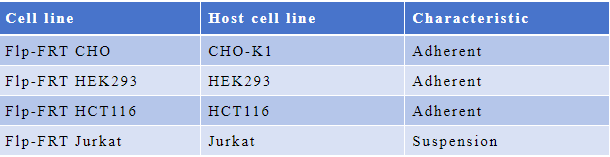
2. Integration of the target gene:
An expression vector containing the target gene and an expression vector containing Flp recombinase are co-transfected into the cells from step 1. Flp recombinase mediates site-specific recombination between the FRT sites in the host genome and those in the expression vector, achieving integration of the target gene and enabling stable expression under the control of the promoter.
Carrier 1:

Overexpression of Flp recombinase, no resistance required, no stable integration required
Carrier 2:

Contains target gene and second resistance gene selection marker
Reorganization process:

Final formation:

After recombination, positive cells can be selected through the second resistance gene, and the cells are tolerant to resistance gene-2 and sensitive to resistance gene-1.
Advantages of the Flp-FRT system
Site-specific integration
preventing random integration into random chromosomal locations
Controllable copy number
The copy number of the target gene can be controlled by the copy number of the Flp-FRT cells
Stable expression
Compared to random integration, this expression system is more stable and can be screened with resistance gene 2 and verified with resistance gene 1
High expression levels
high recombinase integration efficiency, and integration in active transcriptional regions
Short experimental cycles
Selecting a single copy of the genome eliminates the need for limiting dilution to prepare single clones.
Stable Cell Line Construction Services
Reqbio provides stable cell line development services based on the “Flp-FRT Site-directed Integration System”. To date, we have successfully generated over 200 stable cell line models, demonstrating extensive experience in site-specific genome engineering. Please contact us to discuss your project requirements.
| PROJECT | Flp-FRT systems | |
|---|---|---|
| Cell applicability | 4 types of cells inside | |
| Efficiency | high | |
| Random integration | N | |
| Biosafety Level | BL1 | |
| Gene transduction Capacity | - | |
| Positive rate after selection | high | |
| Time line | Gene synthesis& plasmid construct | 4-5 weeks |
| Virus package | - | |
| Pool stable cell selection | 1-2 weeks | |
| Monoclonal cell | Optional | |
| total | 5-7 weeks | |
| Workload | low | |
Other stable cell lines
Lentiviral Integration
Plasmid Electroporation
Random Plasmid Integration
Transposon-Based Integration
If you are interested in ordering, please contact us.
Customer help-line
4008-750-250
sales@reqbio.com
Office address:
3rd Floor, No. 6, Lane 222, Guangdan Road, Pudong New Area, Shanghai, China
We Are Pleased to Announce: Global Commercial Licensing Rights for Jurkat E6.1, CHO-K1, HEK293, THP-1 and RAJI Cell Lines Officially Secured.
Explore