

Home>
Resources>
Learning>
Articles>
TRKA Cell Models – Empowering Dual-Target Drug Discovery in Neuroscience and Oncology
TRKA Cell Models – Empowering Dual-Target Drug Discovery in Neuroscience and Oncology
TRKA (NTRK1) Cell Models for Neuroscience and Oncology Research
Tropomyosin receptor kinase A (TRKA, encoded by the NTRK1 gene) is a key member of the receptor tyrosine kinase (RTK) family. TRKA is the high-affinity receptor for nerve growth factor (NGF) and plays critical roles in neuronal development, survival, and pain perception. In addition, TRKA overexpression or NTRK1 gene fusion-derived chimeric oncogenes can drive the initiation and progression of multiple tumor types, making TRKA an attractive target with dual significance in neuroscience and pan-cancer targeted therapy.
To support TRKA-targeted drug discovery, Reqbio has developed three ready-to-use cell models:
1.NGF/hTRKA Effector Reporter Cells (RQP74174) – A stable reporter gene cell line expressing human TRKA that quantitatively measures NGF/TRKA pathway activity through luciferase readout.
2.NGF/Canine TRKA Effector Reporter Cells (RQP74230) – A stable reporter gene cell line expressing canine TRKA, suitable for veterinary drug development and cross-species reactivity studies.
3.TRKA CHO-K1 Cells (RQP74508) – A CHO-K1 stable cell line expressing human TRKA, suitable for binding studies, cell-based assays, and receptor-ligand interaction analysis.
For research use only. Not intended for diagnostic procedures. These cell models are designed exclusively for drug screening, mechanism studies, and assay development.
Product Features
1. Stable Expression – All three cell lines stably express full-length human or canine TRKA, with surface expression validated by flow cytometry (Figures 1 and 2).
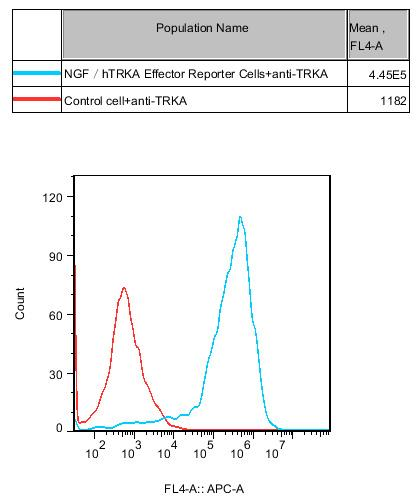
Figures 1 Recombinant NGF/hTRKA Effector Reporter Cell constitutively expressing TRKA.
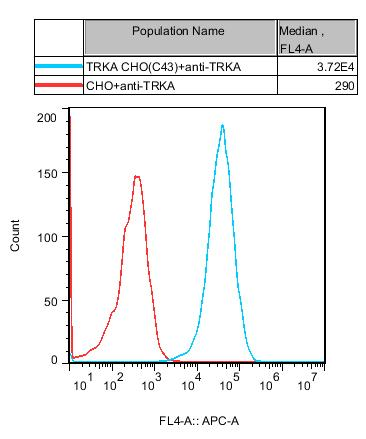
Figures 2 Recombinant TRKA CHO stably expressing TRKA.
2. Functional Reporter System – The reporter gene cells contain an NGF-inducible luciferase reporter that quantitatively detects the activity of TRKA agonists or inhibitors( Figures3,Figures4 and Figures5 dose-response characterization and neutralizing antibody/inhibitor blocking validation.)
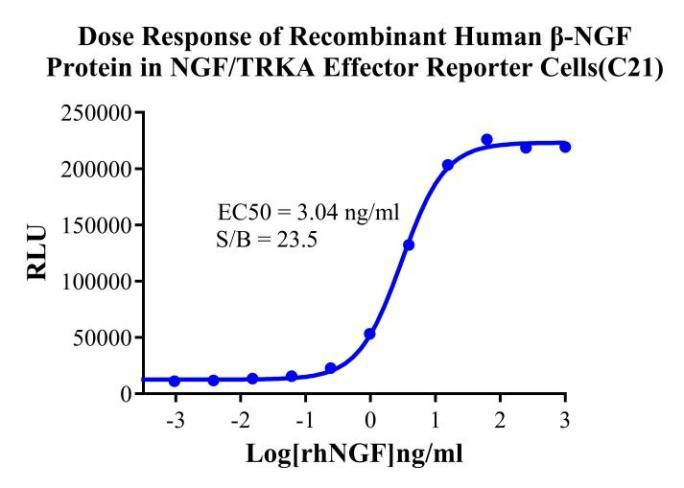
Figures 3 Dose Response of Recombinant Human β-NGF Protein in NGF/TRKA Effector Reporter Cells(C21).
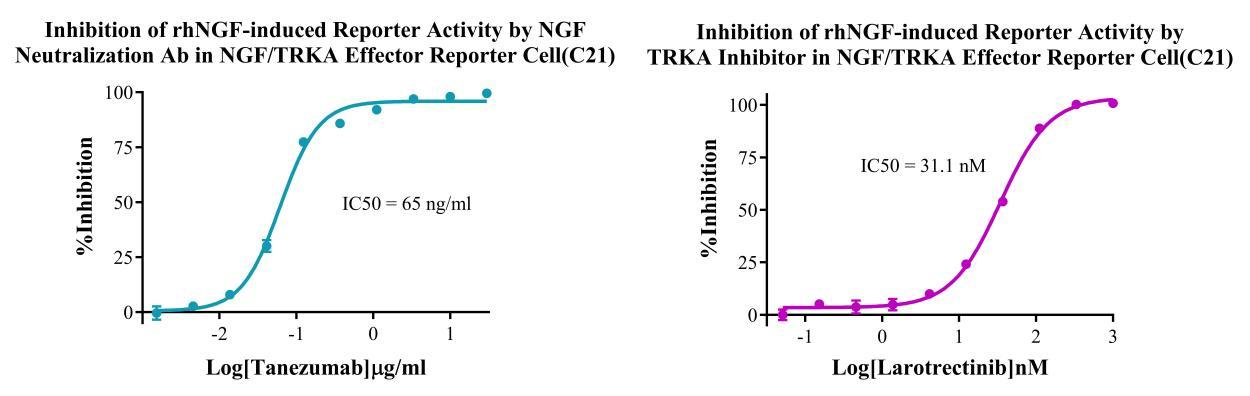
Figures 4 Inhibition of rhNGF-induced Reporter Activity by NGF Neutralization Ab in NGF/hTRKA Effector Reporter Cell(C21). Inhibition of rhNGF-induced Reporter Activity by TRKA Inhibitor in NGF/hTRKA Effector Reporter Cell(C21).
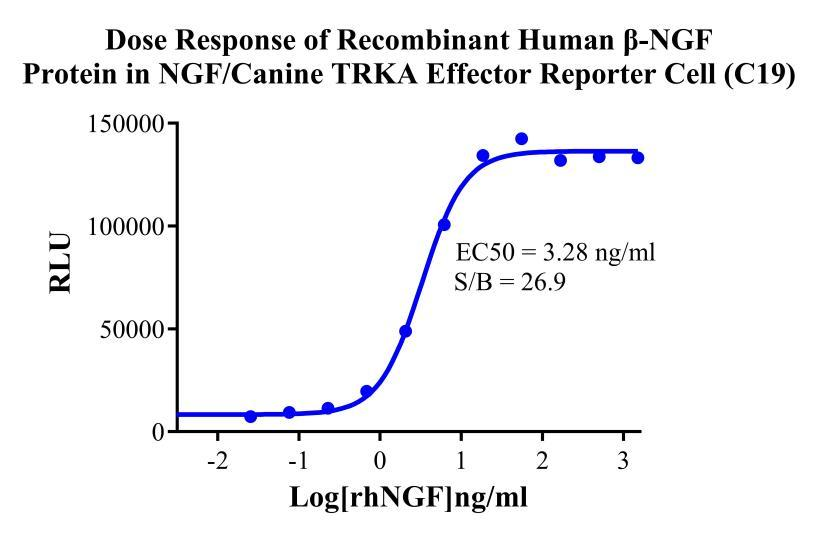
Figures 5 Dose Response of Recombinant Human β-NGF Protein in NGF/Canine TRKA Effector Reporter Cell (C19).
3. Cross-Species Coverage – Both human and canine TRKA reporter gene cells are available to support veterinary drug discovery and species cross-reactivity evaluation.
4. CHO-K1 Background Optimized for Binding Assays – TRKA CHO-K1 cells provide a clean non-neuronal background suitable for NGF ligand or antibody binding studies.
5. Validated Performance – Validated using recombinant human β-NGF protein, NGF-neutralizing antibodies, and TRKA small-molecule inhibitors, with robust and reproducible data including EC50/IC50 values.
6. Ready-to-Use Format – Supplied as cryopreserved vials with detailed culture protocols and assay conditions.
7. Custom Support – Custom cell line development services are available upon request.
Applications
1. TRKA Agonist/Inhibitor Screening for Neuroscience and Oncology Drug Discovery
Pharmaceutical companies are actively developing diverse TRKA-targeted therapeutics, including small-molecule inhibitors (such as Larotrectinib, Entrectinib, and Repotrectinib), monoclonal antibodies, PROTACs, and synthetic peptides (such as Tavilermide). Our NGF/hTRKA Effector Reporter Cells provide a rapid, high-throughput screening platform for evaluating TRKA agonistic or inhibitory activity of candidate compounds. NGF-induced luciferase readouts enable pathway activation quantification, compound potency ranking, and lead optimization, all in a simple 96-well or 384-well format.
2. Functional Characterization and Neutralization Assessment of TRKA Antibodies
For researchers developing monoclonal antibodies targeting TRKA or NGF, our reporter gene cell lines provide a convenient functional evaluation platform. NGF/hTRKA Reporter Cells can be used to assess agonistic or neutralizing activities against the NGF/TRKA pathway. For veterinary drug development, NGF/Canine TRKA Reporter Cells support evaluation of cross-species reactivity and functional activity on canine targets, facilitating translational research from animal models to clinical studies.
3. Mechanistic Studies of TRKA Signaling and Combination Therapy Exploration
TRKA activates multiple downstream signaling pathways in an NGF-dependent manner, including RAS-MAPK, PI3K-AKT, PLCγ, and JAK2-STAT3 pathways, which contribute to tumor proliferation, invasion, epithelial-mesenchymal transition (EMT), perineural invasion (PNI), and cancer-associated pain. Our cell models can be used to investigate signaling activation profiles under different stimulation conditions and to evaluate synergistic effects between TRKA inhibitors and other targeted therapies such as MEK inhibitors or PI3K inhibitors.
TRKA CHO-K1 Cells are also suitable for ligand-binding kinetics studies and receptor dimerization analysis, supporting deeper investigation into the molecular regulation mechanisms of TRKA.
Company Advantages
1. Extensive Expertise in Cell Line Development – Reqbio specializes in stable cell lines and reporter systems for drug discovery, with mature product platforms across multiple kinase targets.
2. Cross-Species Product Portfolio – Human and canine TRKA reporter gene cells are both available to support diverse research and development needs.
3. Validated Functional Assays – Each cell line is validated using NGF proteins, neutralizing antibodies, and small-molecule inhibitors to ensure batch-to-batch consistency, with complete EC50/IC50 datasets provided.
4. Comprehensive Technical Documentation – Detailed SOPs, flow cytometry data, and assay validation reports are provided.
5. Flexible Collaboration Models – Custom cell line development, co-development, and exclusive licensing options are available.
6. Technical Support – Complimentary pre-sales and post-sales technical support is provided to assist with assay setup and data analysis.
7. For Research Use Only – Products are intended exclusively for non-clinical research applications.
Frequently Asked Questions (FAQ)
1. What is the difference between NGF/hTRKA Reporter Cells and NGF/Canine TRKA Reporter Cells?
The former expresses human TRKA and is suitable for human therapeutic development, while the latter expresses canine TRKA and is intended for veterinary drug development and cross-species reactivity studies. Both cell lines contain an NGF-inducible luciferase reporter for quantitative pathway activity measurement.
2. Have these cell lines been validated using known TRKA-targeted drugs?
Yes. All three cell lines have been validated using recombinant human β-NGF protein, NGF-neutralizing antibodies, and TRKA small-molecule inhibitors such as Larotrectinib. The reporter gene cells demonstrate clear dose-dependent luciferase responses and inhibitor-mediated blockade effects.
3. What assays can NGF/hTRKA Effector Reporter Cells be used for?
They can be used for agonist screening (e.g., NGF mimetics and TRKA agonistic antibodies), inhibitor screening (small-molecule inhibitors, PROTACs, and neutralizing antibodies), potency ranking, batch release testing, and mechanism studies using pathway inhibitors as controls.
4. Can these cells be used for in vivo studies?
No. These cell lines are intended exclusively for in vitro research use and have not been validated or supplied for animal studies.
5. How can I obtain quotations, technical documents, or trial samples?
Please contact us at sales@reqbio.com or visit our website. We provide complimentary technical consultation and product documentation.


news recommendation
CaSR: The Calcium Homeostasis Sentinel and a Core GPCR Target for Metabolic and Kidney Disease Research
CD3E: The T-Cell Activation Switch and Cell Models for Targeted Therapeutics
NFAT Signaling Pathway: A Critical Target for Drug R&D and Cell Models
TSHR Cell Model for Thyroid Cancer Drug Screening | GPCR Assay Platform-Reqbio
We Are Pleased to Announce: Global Commercial Licensing Rights for Jurkat E6.1, CHO-K1, HEK293, THP-1 and RAJI Cell Lines Officially Secured.
Explore